Méridien · A counterfactual from the archives
This countrydoes not exist.
In February 1968, nine rulers met in Dubai and signed up for one federation: the seven Trucial States, Bahrain and Qatar. For three years the map of the Gulf hung on their negotiations. This is the story of how nine became seven, told from the documents, on the map that never happened.
Open the file
THE NINE · 1968–1972 · ALL DATES FROM THE PUBLIC RECORD · COASTLINES: NATURAL EARTH DATA
File 01 · The countdown
Four years that drew the map
Britain announced in January 1968 that it would leave the Gulf by the end of 1971. Everything that follows happened inside that deadline.1
Jan 1968
Britain gives notice
the protecting power announces withdrawal from east of Suez by the end of 1971
18 Feb 1968
The handshake
Sheikh Zayed and Sheikh Rashid agree to unite Abu Dhabi and Dubai, and invite the neighbours
25–27 Feb 1968
The Nine sign
in Dubai, nine rulers agree on a Federation of Arab Emirates: seven Trucial States plus Bahrain and Qatar
1968–1971
Three years of negotiation
capital, constitution, representation: the questions that would not close
15 Aug 1971
Bahrain leaves
declares independence on its own
3 Sep 1971
Qatar leaves
follows three weeks later
2 Dec 1971
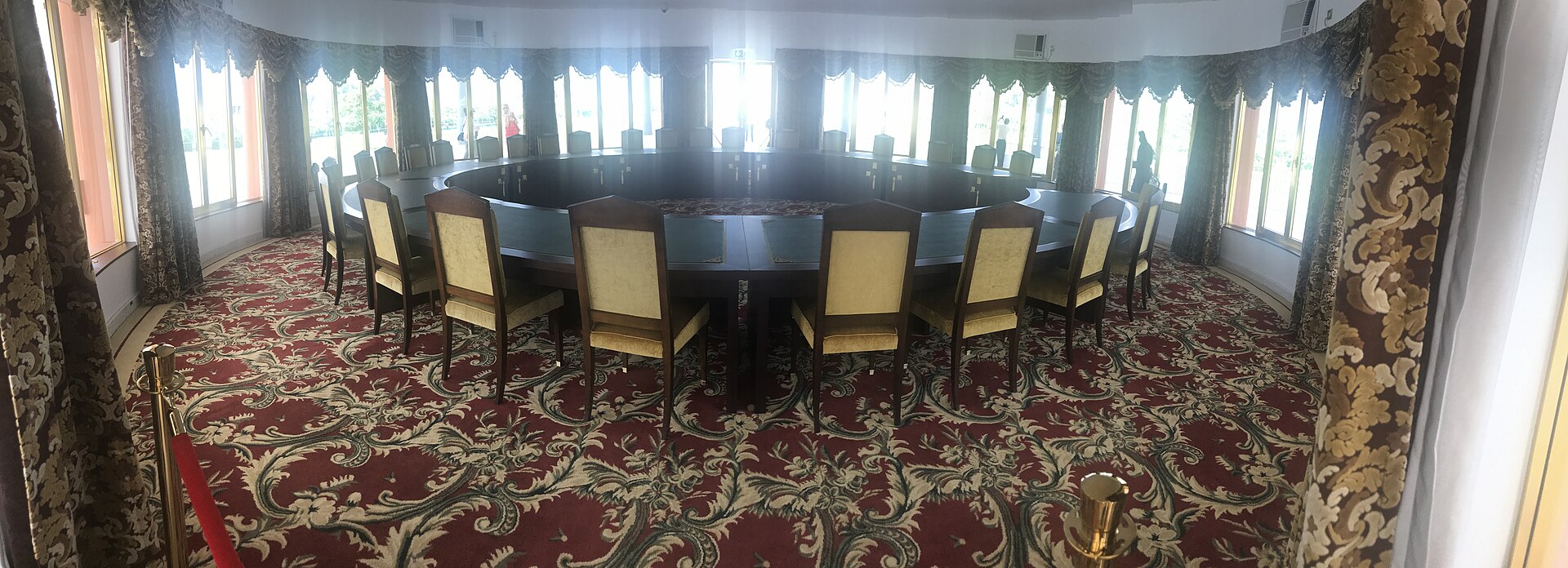
Six sign at Union House
the United Arab Emirates is founded in Dubai, on the site where the Etihad Museum now stands
10 Feb 1972
Ras Al Khaimah joins
the seventh emirate completes today's map
File 02 · The map that wasn't
Nine members, one question: whose union?
The map explains why the negotiations were hard. Two of the nine, Bahrain and Qatar, were states-in-waiting with their own institutions and ambitions; the seven others were smaller emirates used to running their own affairs.1
The capital
Abu Dhabi hosted the provisional meetings, Bahrain saw itself as the natural centre, and a purpose-built capital was discussed. The question was never settled for nine.
Representation
Bahrain, the most populous member, wanted votes to follow population. The smaller emirates wanted one ruler, one voice. Neither side moved.
The constitution
Drafts circulated for three years while committees argued over union powers. Qatar meanwhile prepared a constitution of its own.
Every sticking point above comes from the negotiation record; this story invents no alternative outcomes.1
File 03 · The split
Two exits in three weeks
By the summer of 1971 the nine-member federation existed mostly on paper, and the deadline was months away. Bahrain moved first.1
15.08
03.09
On 15 August 1971 Bahrain declared independence alone. On 3 September, Qatar did the same. The federation of nine was over before it had a constitution, a capital or a flag.
What remained was the original core: the seven Trucial States that had started the process, minus the two neighbours who had options of their own.
File 04 · Union House
Six signatures, then seven
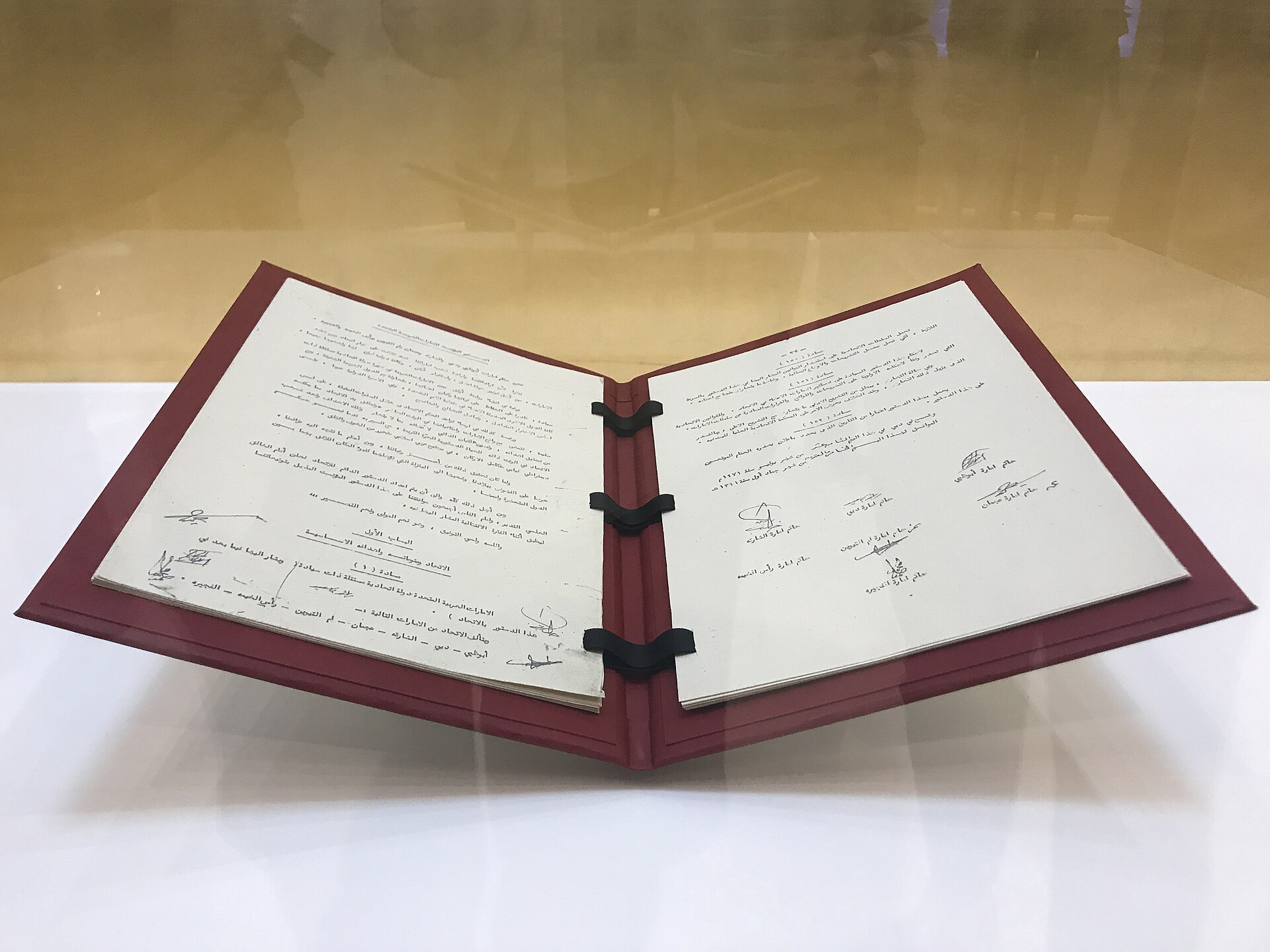
On 2 December 1971 the six remaining rulers signed the union at Union House in Dubai. Ras Al Khaimah held out for ten more weeks and joined on 10 February 1972.1
File 05 · The building
A museum shaped like the signature
The Etihad Museum opened in January 2017 on the site of the signing: some 25,000 square metres, most of it underground, with eight permanent galleries.4
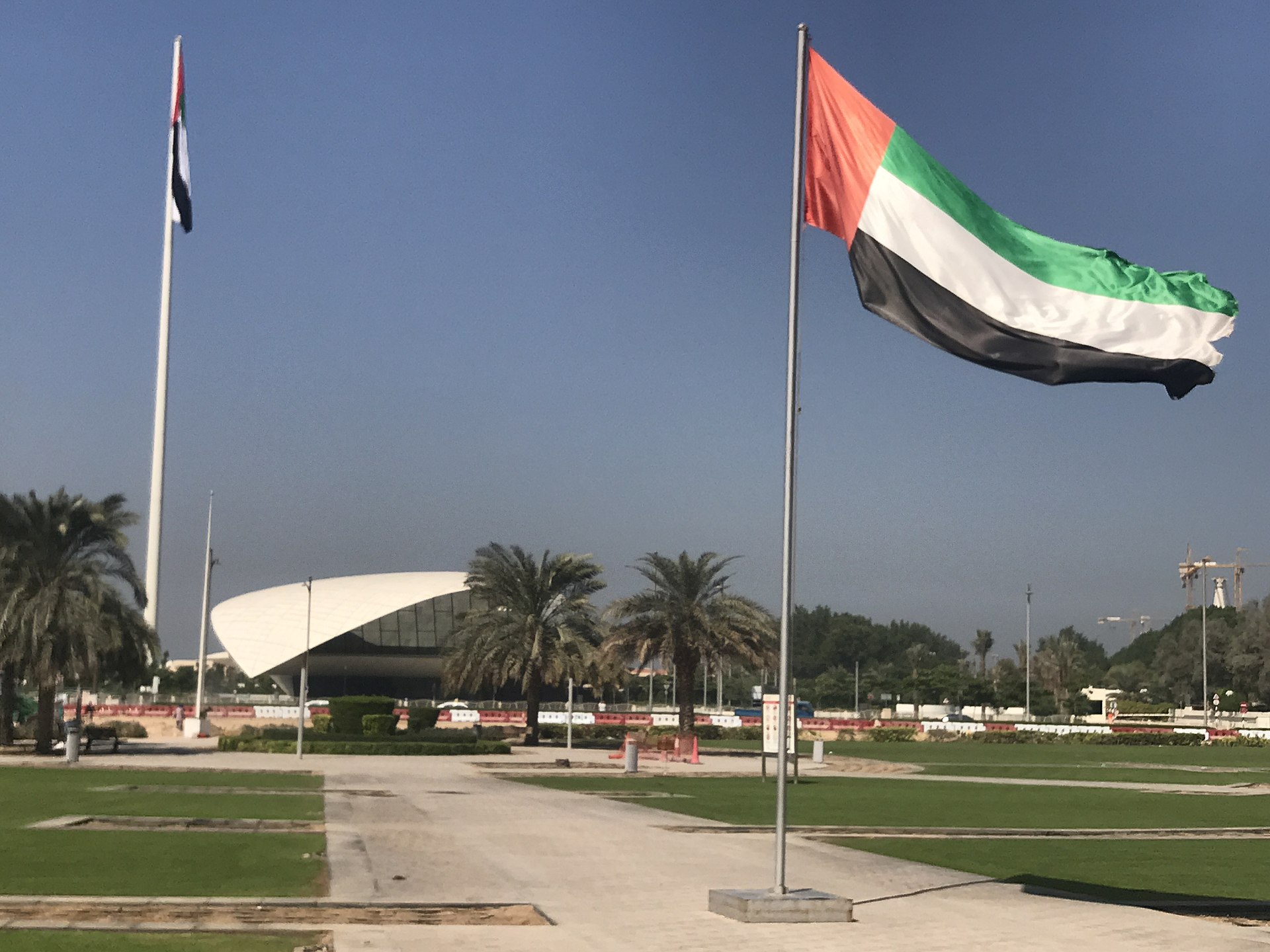
The architecture retells the document. The roof of the pavilion curves like the parchment of the treaty; in front of it stand seven gilded columns, one for each pen that signed.3
Underneath, the galleries walk the same four years this story does — with the room where it ended preserved at the centre.
7
File 06 · The record
Sources
Dates and negotiation history follow the public record on the Federation of Arab Emirates and the museum's own materials. The counterfactual here is strictly bounded: the map of the nine shows what was signed in February 1968, and nothing that was not.
- 01Wikipedia · Federation of Arab Emirates (1968–1971): chronology and negotiation record
- 02Etihad Museum (Dubai Culture) · permanent galleries and site history
- 03Moriyama & Teshima Architects · Etihad Museum project (manuscript roof, seven columns)
- 04CLAD · Etihad Museum opens in Dubai (size, galleries)
- 05Map data · Natural Earth (via world-atlas), coastlines simplified for this story
- 06Photography · Wikimedia Commons: Lxs (CC BY 4.0), Jjeffreys99 (CC BY-SA 4.0)